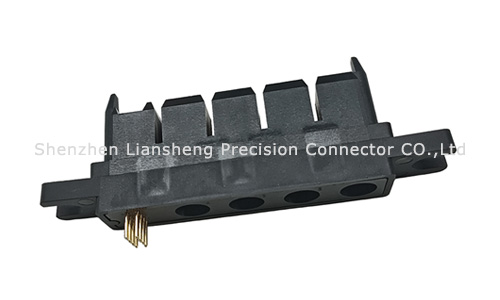
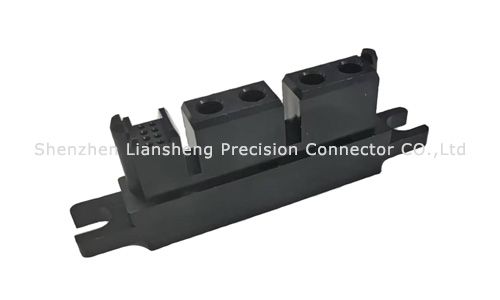
In daily life, board-to-board connectors are widely used in many regions, and most people are quite familiar with them. Today, I will share with you how to select board-to-board connectors with better parameters, as follows:
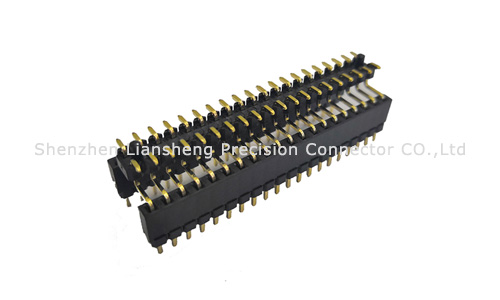
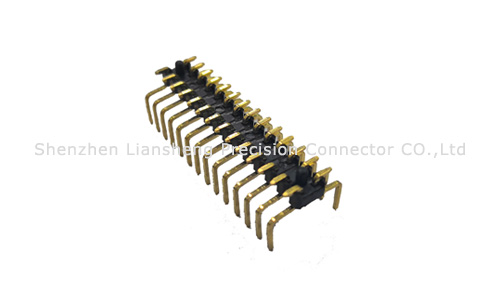
1. Pins, pin spacing, and pitch are the primary criteria for selecting connector models. The number of pins required depends on the total amount of information to be connected. For some surface-mount connectors, such as the header pins shown in the diagram, the number of pins should not be excessive. During the SMT soldering process, prolonged high temperatures can cause the connector plastic to deform and bulge, leading to poor soldering of the pins. Their P800 Flash programmer initially used such header pins and sockets for board interconnections, resulting in widespread poor soldering of the pin headers. After switching to header pins with fewer pins, no poor soldering issues occurred. Currently, as electronic products trend toward miniaturization and precision, connector pin spacing has evolved from 2.54mm to 1.27mm and further to 0.5mm. Smaller pin spacing imposes higher requirements on manufacturing processes. Given the current production technology, blindly pursuing smaller spacing is not advisable.
2. Electrical Characteristics of Connectors The electrical characteristics of connectors primarily include: current limits, loop resistance, grounding resistance, and withstand voltage strength. When connecting high-power resistors, attention must be paid to the current limit of the connector. For transmitting high-frequency signals such as LVDS or PCIe, loop resistance is critical. Connectors should exhibit low and stable loop resistance, typically ranging from several tens of milliohms to over a hundred milliohms.
3. Environmental Characteristics Connector Natural environmental characteristics primarily include: high-temperature resistance, humidity resistance, salt spray resistance, vibration resistance, and impact resistance. Selection should be based on the actual application scenario. For instance, in humid or cold environments, higher requirements are placed on humidity and salt spray resistance to prevent corrosion of the connector's metal contacts. In industrial automation, higher demands are placed on vibration and impact resistance to avoid connector detachment under vibration conditions.
4. Physical Performance Connector mechanical performance includes insertion force, extraction force, and machine error prevention. Machine error prevention is crucial for connectors, as incorrect insertion can cause irreversible damage to the circuit! Insertion force and extraction force are divided into insertion force and separation force. Relevant standards specify limits for insertion force and minimum separation force. From a practical perspective, insertion force should be low, while separation force should be high. Insufficient separation force reduces contact stability, but for connectors that require frequent insertion and removal, excessive separation force increases the difficulty of extraction and shortens mechanical lifespan.





 WeChat Scan
 WeChat Scan